
Organoids, CRISPR, and a Shortcut to Therapies for Rare Blistering Diseases
In rare blistering diseases with few treatment options, Cory Simpson, MD, PhD is using lab-grown skin and gene editing to reveal why skin falls apart — and how it might be repaired.
June 2026

Blistering skin diseases cause a great deal of ongoing suffering. Their characteristic surface wounds cause pain, itching, and infections, and conventional treatments, including topical and oral corticosteroids, provide temporary, limited relief. For autoimmune blistering diseases, like pemphigus vulgaris, monoclonal antibodies (e.g., rituximab) promise longer-lasting relief, while CAAR-T cell therapy that targets B cell-mediated autoimmune diseases is a promising development.
Unfortunately, patients with genetic blistering diseases have few treatment options. Darier disease and Hailey-Hailey disease are autosomal dominant genetic disorders. Each affects less than one in 50,000 people in whom the cellular glue that holds the protective layers of the skin together disintegrates. Skin tissue splits between keratinocytes, leading to blistering, painful wounds, and recurrent infections. In Hailey-Hailey disease, the blisters affect mostly the armpits and groin, while Darier disease affects primarily the scalp, face, neck, and chest.
Despite the identification 25 years ago of causative mutations in calcium pump genes—ATP2A2 for Darier and ATP2C1 for Hailey-Hailey—there are no FDA-approved therapies. Research stalled in part because the main mouse models available, in which the calcium pump genes were knocked out, did not duplicate the biology of the human disease. Without a preclinical prototype, there were limited models to better understand the disease or test potential drugs.

Cory Simpson, MD/PhD, is an associate professor in the Department of Dermatology at the University of Washington. He created Simpson Lab in 2021.
Cory Simpson, MD/PhD, an associate professor in the Department of Dermatology at the University of Washington, is changing that. He has cultured organoid skin and uses CRISPR gene editing in the lab to learn how these diseases develop, as well as to test novel drug treatments, with the ultimate goal of personalized medicine for patients. In the past few years, the development of these sophisticated in vitro tools using human cells has allowed researchers to mimic organ systems in the body. By sidestepping the use of animals in drug discovery and testing, this can lead to faster, cheaper, and more precise drug development.
“Every model has its limits,” said Simpson. “Animal models can do certain things, but mice are not a perfect match to humans. They’re covered in fur and their epidermis is thinner. For some diseases, they just don’t seem to hold up that well.”
Biopsies offer information about a disease, but they are a snapshot in time and don’t provide full insight into how the disease developed or allow drug testing.
“We can replicate the portion of the skin tissue that we need in the lab, then use those small pieces of tissue to observe the pathology as it’s happening in real time.”
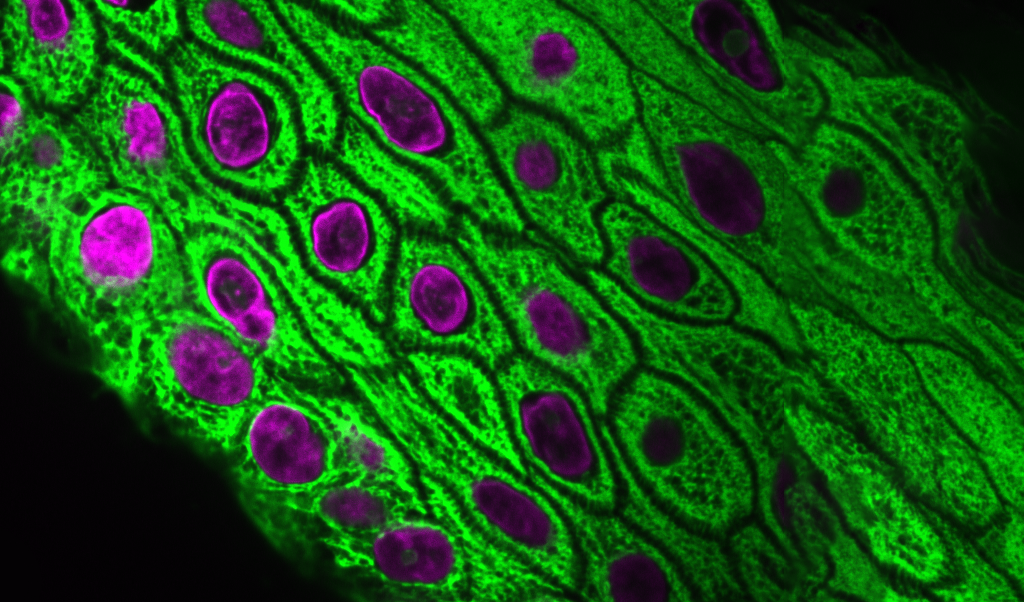
Simpson’s lab has taken a reductionist approach to create an in vitro organotypic epidermis to investigate the core biology of keratinocytes. This avoids the complexity of whole skin, which has hair, oil and sweat glands, neurons, and blood vessels. They use fluorescent proteins and high-magnification microscopy to follow the development of keratinocytes and organelles to understand how epidermis is constructed, the process of epidermal regeneration, and what goes wrong when it breaks down in blistering diseases, which primarily target keratinocytes.
“We can replicate the portion of the skin tissue that we need in the lab, then use those small pieces of tissue to observe the pathology as it’s happening in real time. Then we attempt to fix the pathology by testing out various drugs, particularly repurposed drugs,” said Simpson.
Drug repurposing, in which an approved medicine is used off-label for another indication, is useful for rare diseases since the drug has already been shown to be safe and allows drug developers to sometimes skip the early phases of clinical trials.
Gene editing in cultured keratinocytes
Simpson uses CRISPR, the gene-editing technology, which can be leveraged for two separate purposes: as a research tool to generate precise DNA alterations in organotypic epidermal cultures to replicate blistering disease; and potentially as a therapy to correct genetic variants in diseased skin.
CRISPR/Cas9 is a fast, cheap, and powerful sequence-specific DNA-modifying technology that tens of thousands of scientists use for research. Clinically, the technology has been approved for use in the biologic Casgevy (exagamglogene autotemcel), which treats sickle cell disease and beta thalassemia by modifying the DNA in a patient’s hematopoietic stem cells. CRISPR has been tested for use in humans to treat cancers, including neuroblastoma, as well as other genetic disorders.
Simpson is replicating pathogenic DNA variants found in blistering disease patients to make personalized organotypic models of the disease. He compares this to a variation of Koch’s postulates for infectious diseases. First, the genetic variation is seen in patients with Darier disease.
When the same DNA change is made using CRISPR, the cell line takes on similar characteristics to the diseased cells of patients. And if the change in DNA is then repaired in the cell line using CRISPR, the cells no longer exhibit the diseased state.
“Organoid skin is accessible and can be scaled in ways you can’t with patients.”
“Organoid skin is accessible and can be scaled in ways you can’t with patients,” Simpson said. “We can make many quarter-sized pieces of skin in the lab and do testing on them versus subjecting patients to whatever we want to test.”
They used CRISPR to mutate ATP2A2 in cultured keratinocytes to create an in vitro simulation of Darier disease (Zaver et al. 2023). Comparative mRNA sequencing demonstrated alterations in the EGF receptor signaling pathway that leads to overactivation of a downstream kinase (ERK) in both the cultured cells and in skin biopsies of patients with Darier disease.
They then tested whether the excessive ERK activation could be reduced by inhibiting its upstream kinase, MEK. Multiple MEK inhibitors have already been approved to treat various cancers, including trametinib. Trametinib did, indeed, reverse the diseased state of keratinocytes in their in vitro model, leading to the cells adhering to each other much more strongly.
Knowing a patient’s particular DNA sequence change that causes their Darier disease now allows Simpson to generate an organotypic structure with that same gene variant. This is a step towards finding personalized medicine specific for that patient.
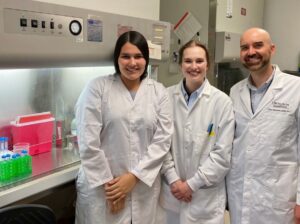
Mentorship in action: Simpson, left, works with Jessica Ayers, center, a PhD student in his lab who supervises Nizhoni Sutter’s research project. Sutter, left, has received DF support.
Gene editing has also been used by other investigators in a 3D skin structure—made of keratinocytes similar to Simpson’s organoid skin—to reverse a genetic variant causing ichthyosis (Apaydin et al. 2026). Using lipid nanoparticles, a DNA editor was delivered to skin cells in which it corrected the sequence of the TGM1 gene. Skin diseases will be some of the most applicable for this technology because skin is easily accessed.
Repurposing drugs for orphan blistering diseases
Repurposing drugs that are already on the market can accelerate rare disease trials, reducing costs, risks, and delays. “This can be a remarkable win for rare skin disease trials that are often harder to get off the ground than for more common conditions like eczema or psoriasis.”
The MEK inhibitor, trametinib, that had proven successful in Simpson’s preclinical model, was used to treat a patient with a severe case of Darier disease that was so debilitating that he was depressed and had suicidal thoughts (Soto-Garcia et al. 2025).
“[Repurposing drugs] can be a remarkable win for rare skin disease trials that are often harder to get off the ground than for more common conditions like eczema or psoriasis.”
This patient had been treated with many different biologic therapies, which are currently used for conditions like psoriasis and atopic dermatitis, none of which worked for him.
“The dermatologist went to the hospital committee that controls charitable use of drugs and made an argument for using this medication [trametinib] because the patient was in such a severe state and nothing typical had worked for him,” Simpson said. It provided relief. “I spoke to the doctor six months after treatment and the patient was still doing well. ” Importantly, Simpson noted the importance of understanding long-term safety of oral MEK inhibitors, which could instead be delivered topically.
Organizations that advocate for rare diseases, including the NIH, realize that collectively rare diseases affect almost 10% of the population. Simpson argues that the bar for clinical studies might need to be lowered for ultra-rare diseases, to reduce the cost and barriers to entry for drug developers. In addition to testing a therapy for Darier disease, could it also be tested on a variety of disorders that also target the cohesion and maturation of keratinocytes, now categorized as epidermal differentiation disorders (EDDs)? This would be advantageous as it unites rare disease communities and could expand the impact of clinical advances from one disease to another.
In the lab with Dr. Simpson, Rafael Homer, left, received DF support as a medical student.
In a symposium prior to the 2026 Society for Investigative Dermatology (SID) annual meeting, an entire day was devoted to EDDs (https://www.pachyonychia.org/2026-edd-symposium/), which include Darier and Hailey-Hailey disease.
Organoids can inform dermatology
Using organoid skin imaging to understand the way skin cells fall apart may lead to therapies, not just for rare inherited blistering disorders, but also for general wound healing and blistering diseases that are not genetic, like pemphigus. Pemphigus is caused by autoantibodies that recognize the substance that glues the cells together.
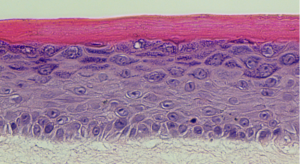
Organoid epidermis histology. Image provided by Dr. Cory Simpson from his research on the organotypic epidermis model.
“Perhaps medications, like the ones that lead to MEK inhibition and make skin cells stick together more strongly, could be more widely applicable to common diseases that have similar pathology, even though one is immunologic and the other is genetic,” Simpson said. “An innovative aspect of studying rare diseases that is underappreciated is that creating genetic variation to model a disease can teach us about ‘normal’ biology. This could be useful for more common disorders.”
“Could MEK inhibitors even be used in eczema? It might tighten up the skin barrier, making it more impermeable to the allergens and other compounds that shouldn’t get in, and keeping water from evaporating as easily.”
Simpson also studies Grover disease, a more prevalent blistering disorder with identical pathology to Darier disease. Despite having a different etiology, Grover disease also exhibits ERK hyperactivation suggestive that MEK inhibition might be a potential therapy (Simpson et al. 2024).
“Could MEK inhibitors even be used in eczema?” Simpson said. “It might tighten up the skin barrier, making it more impermeable to the allergens and other compounds that shouldn’t get in, and keeping water from evaporating as easily.”
Understanding why skin falls apart in rare blistering disorders can inform strategies for how to put it back together. Combining organoid skin systems with gene editing, researchers like Simpson can observe how pathology unfolds, test drugs in human tissue, and get promising treatments to patients faster. For neglected conditions like Darier and Hailey-Hailey diseases, this evolution has already proven clinically meaningful. Yet, the implications extend further, and a similar approach might be applicable to a wider array of skin diseases. By studying the rare, Simpson and his colleagues may be unlocking more efficient ways to treat the many.
Mark your calendar: The DF Clinical Symposium returns January 27–31, 2027.
References
Apaydin DC, Sadhnani G, Carlaw T, et al. Lipid nanoparticle-based non-viral in situ gene editing of congenital ichthyosis-causing mutations in human skin models. Cell Stem Cell. 2026;33(2):233–252.e12.
Simpson CL, Tiwaa A, Zaver SA, et al. ERK hyperactivation in epidermal keratinocytes impairs intercellular adhesion and drives Grover disease pathology. JCI Insight. 2024;9(21):e182983.
Simpson CL. Leveraging gene-edited cells in organotypic models to discover therapeutic strategies for orphan skin diseases. J Invest Dermatol. 2026 Feb 3:S0022-202X(26)00072-2.
Soto-García D, Dávila-Seijo P, González-Moure C, et al. Trametinib as a promising therapy for Darier disease: case report. Br J Dermatol. 2025;193(2):339–341.
Zaver SA, Sarkar MK, Egolf S, et al. Targeting SERCA2 in organotypic epidermis reveals MEK inhibition as a therapeutic strategy for Darier disease. JCI Insight. 2023;8:e170739.