
From Human Biology to Precision Medicine
Thomas Leung, MD, PhD, is the 2026 recipient of the DF Sanofi-Regeneron Mechanisms of Type 2 Inflammation Mid-Career Award
June 2026


When Thomas Leung, MD, PhD, walked into his postdoctoral laboratory at Stanford University (Stanford) on his first day, he was surprised to discover that graduate students in a neighboring lab already knew who he was. Their principal investigator, a former lab mate, had been sharing a story about him.
As a graduate student, Leung had spent more than three years pursuing a difficult scientific question with limited visible success. Then, near the end of his training, the work came together, resulting in two first-author papers published in Cell and Science. For the graduate students who heard it, the story was meant to inspire perseverance through frustration — a concrete example of how quickly a scientific project can turn.
But Leung does not view that period as time spent standing still. For him, it was the essential work of becoming a scientist: choosing an important question, mastering a scientific toolkit, and developing the confidence to trust his own data. That experience shaped one of the central principles of his career as a physician-scientist: understand the pathogenesis of human disease and make practice-changing discoveries.
Direct access to human disease
It is an ambitious goal that has given his career a clear focus and direction. From his earliest studies of skin repair to his current work in inflammatory skin disease, Leung has been drawn to questions that are shaped by the burden disease places on patients. His aim is to understand disease deeply enough to change what physicians can do for patients.
“I chose dermatology because human skin is more accessible than internal organs,” Leung said. “I believe that directly studying diseased tissue is the most efficient way to understand how human diseases work.”
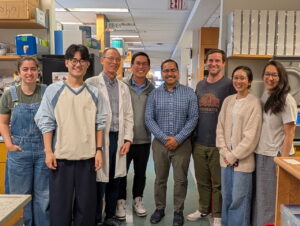
The team from Leung’s lab respects the opportunity to make discoveries that will leave the world in a better place, and patients with better treatment. From left, Lara Rosenbach, Kevin Kim, John Huang, PhD, Thomas Leung, MD, PhD, Satish Sati, PhD, Matthew Dean, PhD, Anna Son, and Linda Zhou, MD/PhD.
Today, Leung is an associate professor at the University of Pennsylvania (Penn) and the Herman Beerman, MD II Professor of Dermatology. His laboratory pursues questions at the intersection of skin biology, inflammation, wound healing, and human disease. Working with colleagues at Penn Dermatology, his team studies human samples, uses cutting-edge genomic approaches to generate hypotheses about disease mechanisms, and builds models to test them.
The overarching goal is not simply to describe disease, but to understand how it works well enough to act on it. That approach is already helping move discoveries toward patients. In sarcoidosis — a complex inflammatory disease that can affect the skin and other organs — work from Leung’s laboratory has identified disease pathways that are now being translated by a pharmaceutical company into potential new therapeutic strategies.
Beyond trial-and-error in AD
This philosophy of targeted translation now drives the laboratory’s latest focus, supported by the DF Sanofi-Regeneron Mechanisms of Type 2 Inflammation Mid-Career Award. The award will fund a critical investigation into therapeutic resistance in atopic dermatitis (AD).
The questions that drive Leung’s laboratory often begin in clinic. One patient improves dramatically on a therapy, while another patient with the same diagnosis continues to suffer. To Leung, that difference is not simply a clinical frustration; it is a biological clue. He looks for clinically meaningful questions that remain unanswered.
Eczema is often spoken of as an itchy rash, but for many patients, it is far more than that. It can mean nights of broken sleep, skin that burns or bleeds, clothing choices dictated by flares, children who cannot concentrate in school, adults who struggle at work, and families exhausted by the daily burden of chronic disease.
The past decade has brought remarkable progress. New therapies have transformed care for many patients with moderate-to-severe AD. Yet even today, many patients still do not improve satisfactorily, while others cycle from one therapy to another before finding meaningful relief. Leung wants to identify the biological signals that explain why some patients respond well to treatment while others continue to struggle.
“The goal is to move beyond trial-and-error and develop precision medicine for eczema.”
“The goal is to move beyond trial-and-error and develop precision medicine for eczema,” Leung said.
Rather than guessing which medicine might work best, Leung wants to understand what each patient’s skin and immune system are revealing at a molecular level. A standard skin biopsy can show which immune cells are present, but modern genomic tools can go much deeper. They can identify which molecular signaling pathways are turned on within specific cell types and which pathways may be driving inflammation. Leung plans to use these molecular patterns to distinguish one patient from another, turning clinical heterogeneity into actionable knowledge.
A lifelong partnership
Leung’s relationship with the Foundation began early in his career. In 2011, he received a DF Investigator Research Fellowship, followed by a Career Development Award (2012-2014) in the physician-scientist category.
Early DF funding helps young investigators make the transition during a vulnerable period when they must move from being trainees with promise to independent scientists with a program of their own.

Leung, left, and his team of trainees during a dinner break at a Society for Investigative Dermatology meeting, From Penn Linda Zhou, MD/PhD, Katherine Nabel Smith, MD/PhD, Jennifer Chen, MD/PhD, and Shiv Zaver, MD/PhD. Second from right is Jonathan Park, MD/PhD from Northwestern.
“That funding really helped bridge those very early years,” Leung said. “That time period has been shown over and over again to be the most vulnerable for budding academic scientists across all medical specialties. We’re fortunate to have the Dermatology Foundation directly addressing this problem.”
Leung said the Foundation’s support sent a powerful message: that the specialty saw value in his potential to be a scientific investigator and were willing to invest in his research. And that is the core of the Foundation’s mission: to support promising minds at pivotal moments when confidence, momentum, and peer recognition can alter the trajectory of a career.
Paying it forward
Leung’s appreciation for the Foundation’s early investment is closely tied to his gratitude for the mentors who shaped his path. From Al Lane, MD, FAAD (former chair of dermatology at Stanford), he learned that kindness and empathy are as vital as clinical competence and technical expertise. From Nobel laureate David Baltimore, PhD, in whose laboratory he completed his doctoral thesis, he learned the foundations of how to think and operate as a scientist. From George Cotsarelis, MD, FAAD (former chair of dermatology at Penn), he learned the importance of reliability.
Those lessons now shape the way Leung leads his own laboratory and guides the next generation.
“The academic path will always be a harder road.” he said. “More time spent working with less pay. There is no way around that. At the same time, it is a privilege to have an opportunity to make discoveries that will leave the world in a better place.
“My job as a mentor is to try to make this road just a little bit easier for future trainees.”
“My job as a mentor is to try to make this road just a little bit easier for future trainees.”
That commitment is reflected in his work with physician-scientist trainees. Over the past decade, Leung has helped build a research residency pathway that gives young dermatologists the time, mentorship, and expectations needed to develop as investigators. For him, training future physician-scientists is not separate from discovery; it is how the field ensures that the next important questions will be asked.
Leung also gives back to the Foundation in a leadership capacity. In 2021, he joined the Foundation’s Medical and Scientific Review Committee, where he helps evaluate and support the next generation of dermatology investigators. For him, this work is stewardship: identifying others whose ideas, discipline, and potential deserve the same kind of early investment that helped shape his own career.
The full arc of investment
The story that once circulated among graduate students was meant to teach persistence. But Leung’s story also reveals the full arc of investment in early-career science: an independent laboratory launched, complex diseases more deeply understood, patients brought closer to lasting relief, new therapeutics moving toward development, and future scientific leaders trained.
Invest in discovery. Donate to the Dermatology Foundation today!
References
- Leung T.H., Hoffmann A., and Baltimore D. One nucleotide change in a kappa B site can determine cofactor specificity for NF-κB dimers. 2004. Cell. 118(4): 453-64. PMID: 15315758.
- Covert M.W., Leung T.H., Gaston J.E. and Baltimore D. Achieving Stability of LPS-Induced NF-κB Activation.2005. Science. 309(5742): 1854-7. PMID: 16166516.