
Making Progress in Hidradenitis Suppurativa Patient Care
Haley Naik, MD, MHSc, is helping advance earlier diagnosis, timely treatment and targeted therapies that are changing the outlook for people with hidradenitis suppurativa.
October 2026


Nearly three million Americans suffer from hidradenitis suppurativa (HS), an incredibly painful relapsing inflammatory skin disease characterized by debilitating boils and abscesses that can progress to dermal tunnels and scarring.
“This is not a rare disease,” said Haley Naik, MD, MHSc, and professor in the Department of Dermatology, UCSF School of Medicine. “Yet, since its first report in the early 19th century, it has been under-recognized and misdiagnosed as an infectious condition or blamed on poor hygiene.”
“Since its first report in the early 19th century, it has been under-recognized and misdiagnosed as an infectious condition or blamed on poor hygiene.”
Medical education about HS has been lacking and, until recently, there has been little funding devoted to research, which contributes to the lack of understanding, awareness, and development of effective therapies for this condition. To help address this, Naik was recruited to UCSF to develop an HS program. She leads a team that provides care and engages in translational research aimed at improving treatment and multidisciplinary care of people living with HS.
Screening tests lead to accurate diagnosis
Prior to the 2010s, the challenges about making an accurate diagnosis meant that estimates of the prevalence of HS ranged widely, from 0.1% to 5%. Naik is part of an effort by the International League of Dermatological Societies to get a more precise measure of prevalence of HS in individual countries (Bouazzi et al. 2026). Using the Global Hidradenitis Suppurativa Atlas (GHiSA) study screening questionnaire, which offers excellent diagnostic accuracy, the group has determined that roughly 1% of the global population suffers from HS.
“Accurate and early diagnosis is everything for this patient population, who are dealing with a disease with potentially permanent ramifications if not treated early,” Naik said. “We have to get available and effective treatments to the people who need them, and in a timely manner, to change the trajectory of their disease.”
“Accurate and early diagnosis is everything for this patient population, who are dealing with a disease with potentially permanent ramifications if not treated early.”
Historically, it has taken between 7 and 10 years for patients to have HS diagnosed (Bouazzi 2026). At least part of this is due to persistent, ongoing barriers to treatments for certain groups. HS is more prevalent in women and those with skin of color (Vlassova et al. 2015), while recent epidemiologic data shows that HS is also more common in the US in lower socioeconomic status groups (Sanchez-Anguiano et al. 2025).
“Teasing out how much of this is related to the genetics of certain groups versus their socioeconomic status, their environments, and the foods they have access to is currently an important subject of investigation,” Naik said.

Dr. Haley Naik is a professor in the Department of Dermatology, UCSF School of Medicine. She leads a multicenter, longitudinal cohort study at UCSF, the Hidradenitis Suppurativa Prospective Observational Registry and Biospecimen Repository to understand the clinical and biological aspects of the disease.
Naik leads a multicenter, longitudinal cohort study at UCSF — the Hidradenitis Suppurativa Prospective Observational Registry and Biospecimen Repository (HS PROGRESS) — to understand the clinical and biological aspects of the disease. Data from HS PROGRESS suggests that the diagnostic delay is now closer to four years. This is likely due to the development of effective biologic treatments, expanded HS knowledge and awareness, and continuing medical education across specialties. As well as the work of the HS Foundation, a physician-led nonprofit organization whose stakeholders are people with HS, their caregivers, healthcare professionals and investigators, and of which Naik is president.
Yet, while dermatologists are trained to recognize HS, many patients with the initial symptoms are diagnosed first by their primary care doctor or in the emergency room, not by a dermatologist.
“We need to do more work educating frontline healthcare professionals about diagnosis,” said Naik. “This should include a validated screening questionnaire to ensure timely diagnoses and referrals so dermatologists can treat patients as early as possible.”
Naik and colleagues published an expert framework defining moderate disease and encouraging timely intervention to prevent disease progression (Martorell et al. 2026).
“The work we are doing to raise awareness is making a dent. Specialists are now seeing patients early enough in the course of their disease that we often find ourselves waiting to ensure they meet diagnostic criteria,” said Naik. “It means we have an opportunity to aggressively manage patients when we can see that their disease is progressing.”
HS was seen primarily as a surgical disease
Pain is perhaps the most significant symptom of HS, degrading quality of life and impeding therapeutic management (Barnes et al. 2026). The management of HS relies on reducing this pain, controlling inflammation and itch, and removing damaged tissue. Before the advent of FDA-approved biologic therapies, surgery was a cornerstone of HS care.
Although surgery remains part of the treatment algorithm for moderate-to-severe HS, its role has evolved and is no longer considered first-line in HS management. Clinicians now approach HS care by first controlling the inflammatory component of the disease with biologics or other medical therapies. Adalimumab was the first biologic approved by the FDA to treat moderate-to-severe HS in 2015.
“HS is an inflammatory disease that we chased with a scalpel. It was an approach born out of desperation to offer relief from this incredibly painful and disfiguring condition.”
There are now also 2 approved IL-17 inhibitors for moderate-to-severe disease, including secukinumab (approved for adults in 2023 and pediatric patients older than 12 in 2026) and bimekizumab (approved in 2024 for adults). Then, once the HS is medically optimized and quiescent, surgical interventions can remove permanently disfigured, damaged, or fibrotic tissue, which can still be inflamed, painful, and prone to flare.
The benefits of early intervention
Initiating treatment as soon as a diagnosis is confirmed may minimize development of scarring, severe lesions, and tissue damage that will need surgical removal. Yet, treatment of patients who have the most severe disease is quite different from those patients with mild disease. Treatment options for those with mild disease are limited given that there are no FDA-approved medications for early-stage HS.
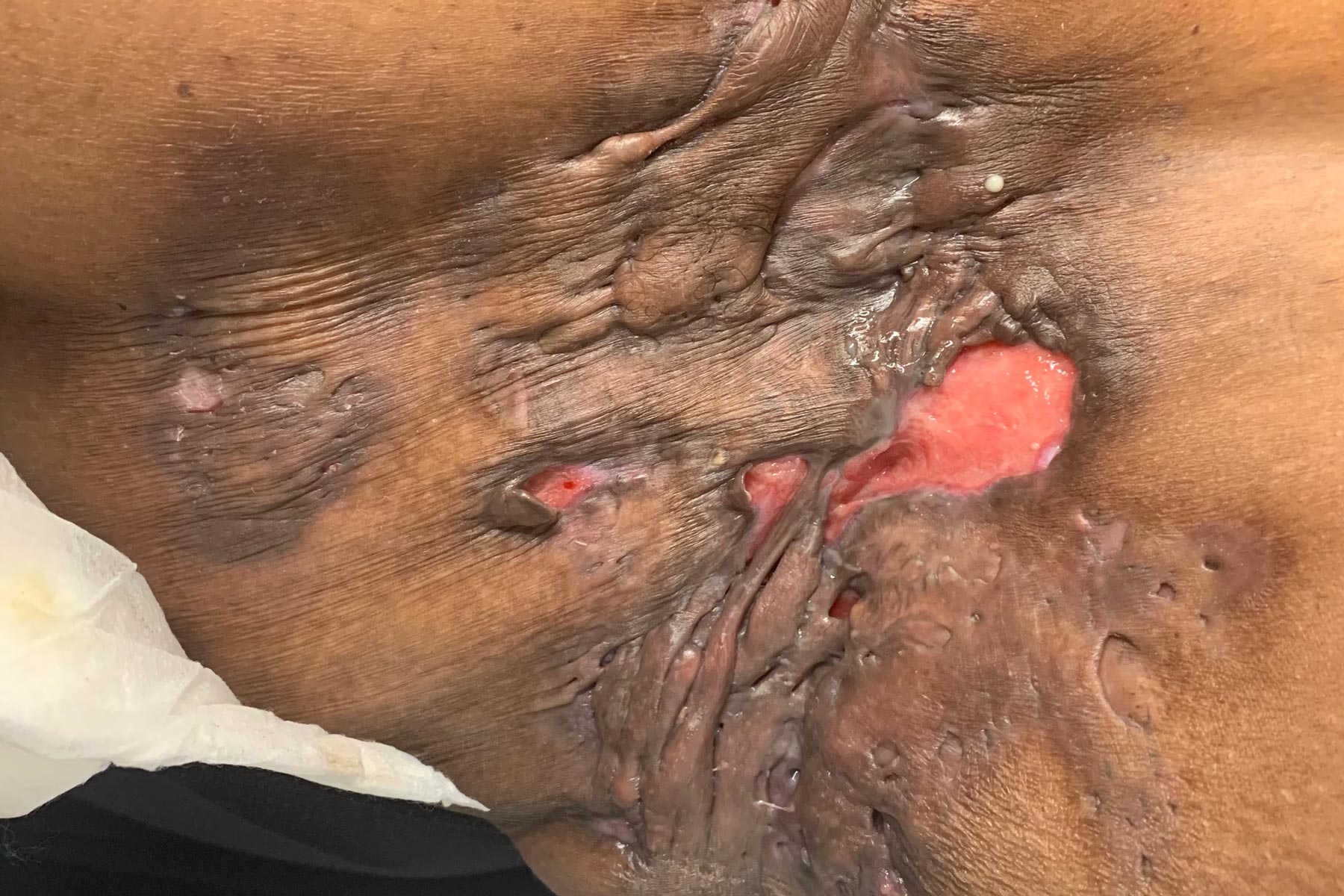
“There’s been little work done in this mild-HS space, which is where we’d ideally want to capture patients,” Naik said. “Now that we’re identifying these patients, we can develop more stringent diagnostic criteria and find biomarkers to help determine long-term prognosis.”
Naik notes that approved biologics are often not available as first-line therapies for moderate-to-severe HS. Instead, clinicians typically have to first demonstrate that antibiotics or hormonal therapies are ineffective before prescribing a biologic.
“Step therapy hurdles limit access to the necessary care,” she said. “And we know that so-called “first-line therapies” like topical and systemic antibiotics are far less effective for moderate-to-severe HS than the biologics that have been tested in rigorous clinical trials.
“When somebody has acne with scarring, we immediately reach for systemic therapy. But with HS, we wait for fibrosis, for scarring, for tunnels to develop before we think about a biologic.
“We are advocating that, once you see HS progression to moderate disease, as defined by the development of a tunnel, scarring, or lesions that impair function, we should be treating with these approved medicines that we have access to.”
“We know that so-called “first line therapies” like topical and systemic antibiotics are far less effective for moderate-to-severe HS than the biologics that have been tested in rigorous clinical trials.”
Unfortunately, there’s also no widely accepted definition of moderate disease in clinical trials. Definitions range from a person having three or more inflammatory nodules or abscesses, one tunnel, or classified as Hurley stage two. In clinical practice, those definitions are even less clear.
“My dermatology colleagues do a great job of diagnosing HS,” said Naik. “But they need to know what moderate HS looks like, since it varies from one individual to another. If somebody has only one lesion, but it’s in their groin and prevents them from sitting or working or performing activities of daily living, I would argue that this is at least moderate disease. We shouldn’t have to wait until patients have multiple interconnected tunnels before starting a biologic.”
The degree of inflammation occurring in HS is several-fold greater than what is seen in other inflammatory skin diseases (Lowe, Naik et al. 2020). A partial response to therapy indicates that the patient might respond to an increased dose of their current medicine — dose escalation benefits many who have a partial response to adalimumab (William et al. 2023) — or layered therapies, such as the addition of systemic antibiotics, hormonal therapy, or switch to a different biologic.
“The amount of each of these biologics required to control the inflammation in HS is greater than what is required for diseases like psoriasis, rheumatoid arthritis, or Crohn’s disease,” said Naik. “Since injectable biologics are often administered as a single standard dose, dose escalation can be a challenge, and patients are stuck with a one-size-fits-all approach that may not work.”
Future treatments are in the clinical trial pipeline
Emerging therapies for HS include JAK inhibitors (upadacitinib, povorcitinib, and topical ruxolitinib), Bruton tyrosine kinase (BTK) inhibitors (remibrutinib) and IL-1 inhibitors (lutikizumab).
“Robust multifaceted inflammation in HS led to off-label use of JAK inhibitors in the clinical literature, and this led to interest in testing them for HS in clinical trials,” said Naik. “The next step will be to show whether biologics and small molecule inhibitors, when used in a timely manner at the first sign of moderate HS, prevent disease progression.
“When I started my career, it felt like we had nothing but promises and handholding for our HS patients,” said Naik, who was the recipient of a 2015 Dermatology Foundation Career Development Research Award. “Over the last 10 years, we’ve developed a better understanding of disease biology, improved recognition of comorbidity burden, and have more targeted therapeutics for HS, with even more coming down the pipeline. The understanding and care of HS will look totally different by the time I end my career.”
“The next step will be to show whether biologics and small molecule inhibitors, when used in a timely manner at the first sign of moderate HS, prevent disease progression.”
There is now guidance to help manage, not only the average HS patient who can get enrolled in a clinical trial, but also those who have been understudied and marginalized, including adolescents, pregnant women, people with chronic infectious conditions like HIV, hepatitis, and TB, and those with cancer.
“I remain optimistic about what clinical care for people with HS looks like today and it’s only going to get better. There’s much more funding in this field and so much interest and motivation to improve the condition of these patients.”
Donate to the Dermatology Foundation to support research that invests in your future.
References
Barnes LA, Rinderknecht FB, Orenstein LAV, Naik HB. Global Pain Management Trends and Barriers to Care in Hidradenitis Suppurativa. Dermatology. 2026;242(3):252–263.
Bouazzi D, Lophaven S, Hagan PG, et al. Evaluating the diagnostic accuracy of a screening questionnaire for detecting hidradenitis suppurativa: a pooled analysis of accuracy measures from the Global Hidradenitis Suppurativa Atlas (GHiSA) study. Br J Dermatol. 2026;194(5):869–878.
Johnson CE, Naik HB. Microbiome Perturbations in Hidradenitis Suppurativa. Dermatol Clin. 2025;43(2):193–202.
Martorell A, Ingram JR, Sayed CJ, et al. Defining Moderate Disease and Progression in Hidradenitis Suppurativa: An Expert Framework to Unlock the Window of Opportunity for Prompt Treatment. Am J Clin Dermatol. 2026;27(2):217–226.
National Library of Medicine. ClinicalTrials.gov. 2026. Hidradenitis Suppurativa Prospective Observational Registry and Biospecimen Repository (HS PROGRESS). https://clinicaltrials.gov/study/NCT04115566
Navrazhina K, Garcet S, Frew JW, Zheng X, et al. The inflammatory proteome of hidradenitis suppurativa skin is more expansive than that of psoriasis vulgaris. J Am Acad Dermatol. 2022;86(2):322–330.
Riverain-Gillet É, Guet-Revillet H, Jais JP, et al. The Surface Microbiome of Clinically Unaffected Skinfolds in Hidradenitis Suppurativa: A Cross-Sectional Culture-Based and 16S rRNA Gene Amplicon Sequencing Study in 60 Patients. J Invest Dermatol. 2020;140(9):1847–1855.e6
Sanchez-Anguiano ME, Supapannachart K, Amerson EH, et al. Lower Neighborhood Socioeconomic Status Is Associated with Moderate-Severe Hidradenitis Suppurativa: A Cross-Sectional Study. JID Innov. 2025;6(1):100423.
Vlassova N, Kuhn D, Okoye GA. Hidradenitis suppurativa disproportionately affects African Americans: a single-center retrospective analysis. Acta Derm Venereol. 2015;95(8):990–991. https://pubmed.ncbi.nlm.nih.gov/26073615/
Williams J, Guzik C, Wadhera A, Naik H. Increased Doses of Adalimumab are Associated With Clinical Improvement of Hidradenitis Suppurativa. J Drugs Dermatol. 2023;22(6):615–618.