
On the Art and Science of Skin Immunity
Tiffany Scharschmidt, MD’s independent lab explores how early-life interactions between cellular and molecular mechanisms shape adaptive immune responses to the skin microbiome.
June 2026

As a child, Tiffany Scharschmidt, MD, found an outlet for her creativity through Chinese brush painting. Her fourth-grade teacher, seeing her aptitude and passion, encouraged her to join an adult evening class. She painted throughout her childhood but, as a mother of three and a busy clinician-scientist, Scharschmidt no longer has much time for it.
“These days, I use the creative part of my brain conceptually for my research,” she said. “I don’t see research as algorithmic. It’s more like sitting with the unknown and being creative about how to approach a problem.”
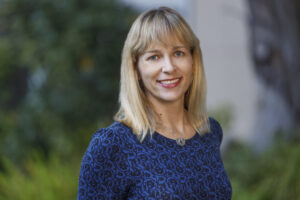
Tiffany Scharschmidt, MD is a professor and vice chair of research in the UCSF Department of Dermatology and has run her own lab since 2016.
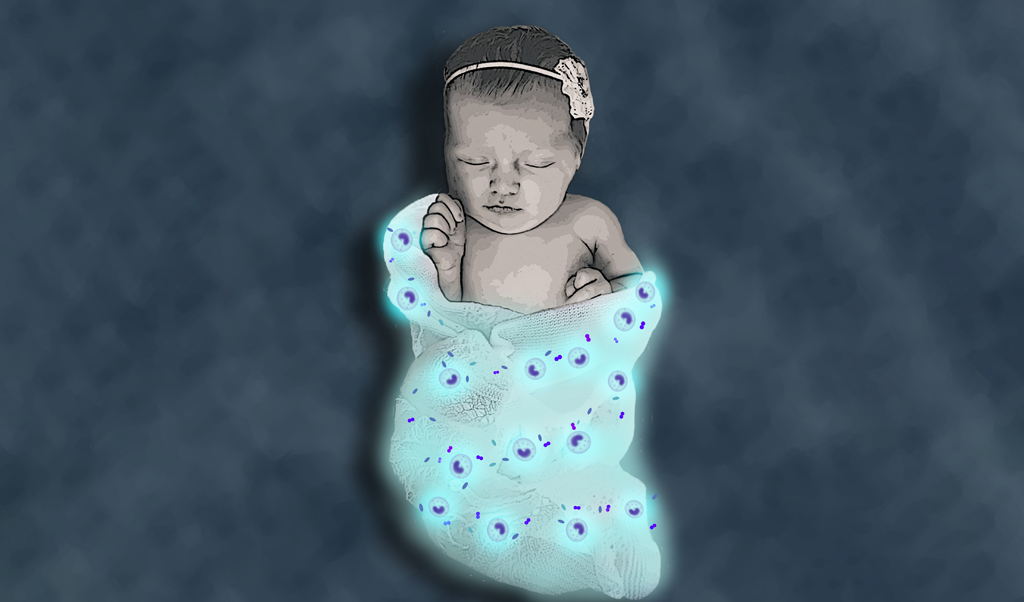
Still, she’s able to find outlets for her visual artistry. To accompany an article demonstrating the role played by skin microbes in the accumulation of regulatory T cells (Tregs) in hair follicles, she digitally manipulated a photo of her newborn son with an artistic representation of the skin microbiome — it appeared on the cover of Cell Host Microbe (Scharschmidt et al. 2017).
“I don’t see research as algorithmic. It’s more like sitting with the unknown and being creative about how to approach a problem.”
“It was my visual strengths, combined with my curiosity about systemic disease, and the accessibility of skin for research, which led me to a dermatological research career,” said Scharschmidt, who is professor and vice chair of research in the UCSF Department of Dermatology and has run her own lab since 2016. Her parents, both of whom were physicians, also influenced her career trajectory. Her father, Bruce Scharschmidt, MD, ran a research lab at UCSF in the same building where Scharschmidt’s is now located. Her mother, Peggy Crawford, MD, a dermatologist, was a recipient of the Dermatology Foundation’s Clark W. Finnerud Honorary Award and remains a sustaining member of the Annenberg Circle.
Following graduation from UCSF’s Medical School (2008), Scharschmidt completed an internship at Stanford University before returning to UCSF to join the Dermatology Physician-Scientist Training Program, which combines residency training with a research postdoctoral fellowship. Scharschmidt worked under the research mentorship of Michael Fischbach, PhD and then Michael Rosenblum, MD, PhD, to establish her expertise in both microbiology and immunology. Her independent lab draws on both these disciplines to study the cellular and molecular mechanisms shaping adaptive immune responses to the skin microbiome, with a particular focus on early life.
An early life “window” for tolerance to the skin microbiome
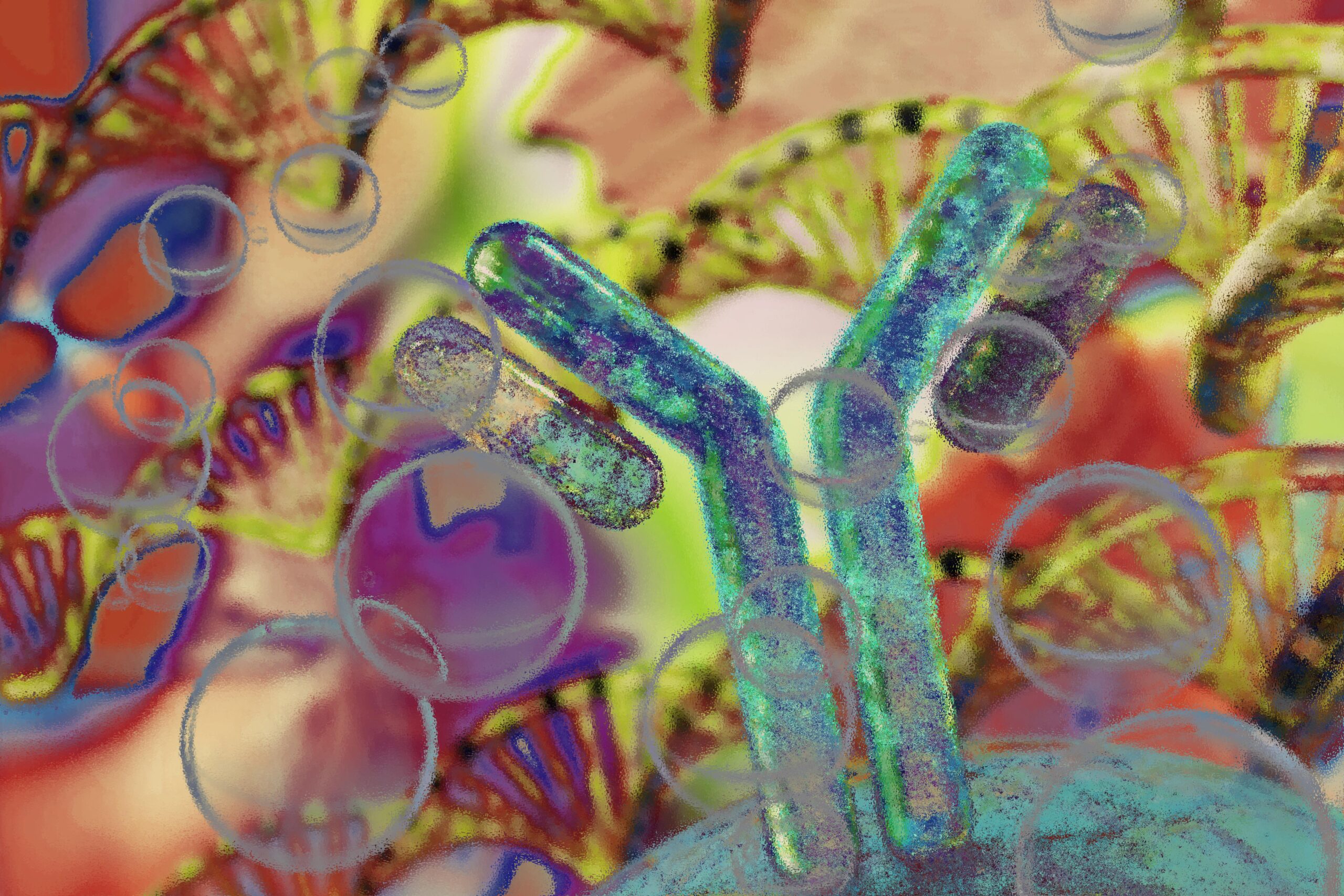
One day each week, Scharschmidt teaches residents and sees patients in a clinic at UCSF Medical Center at Mount Zion, focusing on patients with autoimmune and chronic inflammatory skin diseases, such as atopic dermatitis (AD). Her research has demonstrated that early-life interactions between skin microbes and the developing immune system are required to mount a healthy immune response, i.e. tolerance, to commensal bacteria (Scharschmidt et. al. 2015, Dhariwala et al. 2026).
Work from her lab has helped identify a subset of dendritic cells in newborn skin that are especially equipped at educating our immune system to antigens from commensal bacteria. These antigen-presenting cells help generate regulatory T cells (Tregs), increasing this population of cells that promote a healthy relationship with the skin microbiome (Weckel et al. 2023). In ongoing unpublished work, her team has found that sensing of bacteria-associated ligands by these dendritic cells, for example via toll-like receptor 2 (TLR2), reinforces their tolerogenic function, in yet another illustration of how these early microbial interactions facilitate lifelong skin health.
Potential for novel treatments
Scharschmidt is also passionate about studying how disrupting this healthy early-life dialogue with the skin microbiome contributes to chronic inflammatory skin disease. Understanding this might help answer key outstanding questions, such as “how can we correct processes that lead to eczema before disease even starts” or “how can we modulate the skin microbiome to reduce skin inflammation?” Scharschmidt is trying to answer these thanks in part to a Dermatology Foundation Sun Pharma Research Award (2021–2023) to fund a three-year study into early-life microbe-immune system interactions that contribute to eczema.
“The next stage of research efforts in eczema are focusing on identifying who’s at increased risk for developing AD and intervening early.”
Genetic mutations affecting the skin structural protein, filaggrin, significantly increase risk of AD. Scharschmidt’s team found that neonatal mice with filaggrin mutations exhibit excessive inflammatory responses to skin commensal bacteria (Gonzalez and Scharschmidt 2022), suggesting that “bad dialogue” with skin bacteria might be an early event facilitating eczema onset in patients carrying filaggrin mutations.
Per Scharschmidt “the next stage of research efforts in eczema are focusing on identifying who’s at increased risk for developing AD and intervening early. The goal is to lessen the burden of this disease as opposed to just treating it when it shows up.” Scharschmidt expressed hope that her research would help aid the development of such therapeutics, for example by optimizing composition of the early life skin microbiome or fine-tuning the skin immune system’s response to those bacteria to correct “unhealthy dialogue” before it turns into a full-blown argument.
Inclusion in dermatology
“Now that I’ve run the gauntlet of launching an independent career, it’s important to [ sic] me to focus on supporting young physician scientists,” Scharschmidt said. She is an outspoken advocate for encouraging underrepresented groups to consider a career in dermatology, especially as physician scientists.
“The Dermatology Foundation continues to play an important role in developing the careers of physician-investigators,” Scharschmidt said.
“Having a wide array of life experiences in a specialty is important because that will reflect the wide variety of patients we care for,” she said. “There’s good evidence that creative and innovative science happens when you have a breadth of perspectives and experiences represented on your team.”
She pointed to Medical Scientist Training Programs (MSTPs), at UCSF and elsewhere, as playing a critical part in this effort. These programs cover all medical and graduate school tuition, making the physician-scientist career path accessible even to students for whom financial pressures can be intense.
“There’s good evidence that creative and innovative science happens when you have a breadth of perspectives and experiences represented on your team.”
As someone who only discovered her research calling after starting medical school, Scharschmidt hopes dermatology will continue to support “late-bloomer” on-ramps to research-focused careers, something she notes that the Dermatology Foundation’s Research Award Program has helped facilitate.
Critical Foundation support
“The Dermatology Foundation continues to play an important role in developing the careers of physician-investigators,” Scharschmidt said. “Not everyone knows from the outset that this is their path. Many find it along the way, and funding young researchers is something that the Foundation does really well.”
Scharschmidt received a DF Investigator Research Fellowship (2012) during the first year of her postdoctoral fellowship. She also received a DF Physician Scientist Career Development Award (2013–2015) for a project to identify genetic determinants of S. aureus skin colonization. This award provided her with both financial support and validation during her career transition, experiencing firsthand the level of commitment the Foundation has to support burgeoning scientists.
“Not everyone knows from the outset that this is their path. Many find it along the way, and funding young researchers is something that the Foundation does really well.”
“Halfway through my DF research funding,
I switched labs to learn more about the immune system,” she said. “I was worried about telling the Foundation that the topic and lab had shifted. They simply told me to put in a renewal request and explain what I wanted to do. They understood I wasn’t leaving this path, I was shifting my focus, as many scientists do.
“We’re lucky as a specialty to have the Foundation supporting research,” she said. “What’s special about the Foundation is its focus, not on any particular disease, but on helping individual investigators.”
Donate to the Dermatology Foundation to support research that heals wounds.
References
Gonzalez J, Scharschmidt T. 561 Filaggrin deficiency confers an altered early life T cell response to commensal skin bacteria. J Investig Dermatol. 2022; 142(8):s95. https://www.jidonline.org/article/S0022-202X(22)01012-0/fulltext#:~:text=Flg%2D%2F%2D%20mice%20demonstrated%20heightened,consequences%20for%20skin%20immune%20homeostasis.
Scharschmidt TC, Vasquez KS, Pauli ML, et al. Commensal Microbes and Hair Follicle Morphogenesis Coordinately Drive Treg Migration into Neonatal Skin. Cell Host Microbe. 2017;21(4):467–477.e5 https://www.cell.com/cell-host-microbe/fulltext/S1931-3128(17)30111-7
Weckel A, Dhariwala MO, Ly K, et al. Long-term tolerance to skin commensals is established neonatally through a specialized dendritic cell subgroup. Immunity. 2023;56(6):1239–1254.e7. (on file)