
Breaking New Ground and Breaking Divides in South African Dermatology for Black Africans
Dr. Ncoza Dlova has mentored more than 40 dermatologists, 80% of whom are Black African women and transformed the practice of dermatology in South Africa
December 2025



A trailblazing clinician, researcher, and leader, Dr. Ncoza Dlova has transformed dermatology in South Africa.
As a Black South African living under apartheid, Ncoza Dlova, MD, faced racism at every turn. Yet she broke through systemic barriers to achieve a series of historic firsts. Dlova was the first Black African woman and dermatologist to graduate from the School of Clinical Medicine at the University of KwaZulu-Natal (UKZN) in Durban, South Africa, the first Black African woman to become full professor of dermatology, and the first Black African dean of the medical school, a position she held from 2018 to 2024. Currently, she is chair of the Department of Dermatology at UKZN.
“There was nobody to mentor me as a medical student, dermatology resident or junior consultant dermatologist, and no-one to look up to,” Dlova said. “I had to fend for myself, as my efforts to advance were always met with obstruction. I felt traumatized.”
Dlova grew up in Mtyolo, a small village in South Africa, before moving 450 miles along the coast to attend UKZN. In 1989, Dlova’s medical class of 120 was only one-quarter Black and there was only one Black African professor. Following her medical degree, she completed an internship at a dermatology clinic in a small regional hospital, Livingston, Port Elizabeth (Gqeberha) in the eastern cape.

Dr. Dlova worked closely with the heads of dermatology at UKZN, photographed here during her years as Dean, when collaboration and mentorship were central to her leadership.
“Since there were no Black dermatologists, those African patients were treated by white dermatologists who didn’t speak their language,” she said. “A private dermatologist visited the clinic once a month and patients waited for hours to see him. They did not receive a proper examination or an explanation about their skin conditions. They were prescribed medication and sent off. It was far from ideal.”
Support for medical students
Dlova is warm, generous, and approachable, yet beneath that warmth lies a determination that has carried her forward and allowed her to open doors for her peers, students, and the next generation.
“It’s not just about being first,” she said. “It’s about the social and political responsibility of being a voice for the community I’m part of. I vowed when I became a dermatologist and then head of my department that I would never subject anyone to what I had to go through.”
Prior to Dlova, the UKZN medical school only had white or Indian South African deans for 73 years. She was acknowledged as Best Dean Leader in the College of Health Sciences (2020–2023), an award recognizing her leadership in the School of Clinical Medicine and for improving the atmosphere for staff and students. As dean, she had an open-door policy to engage students.
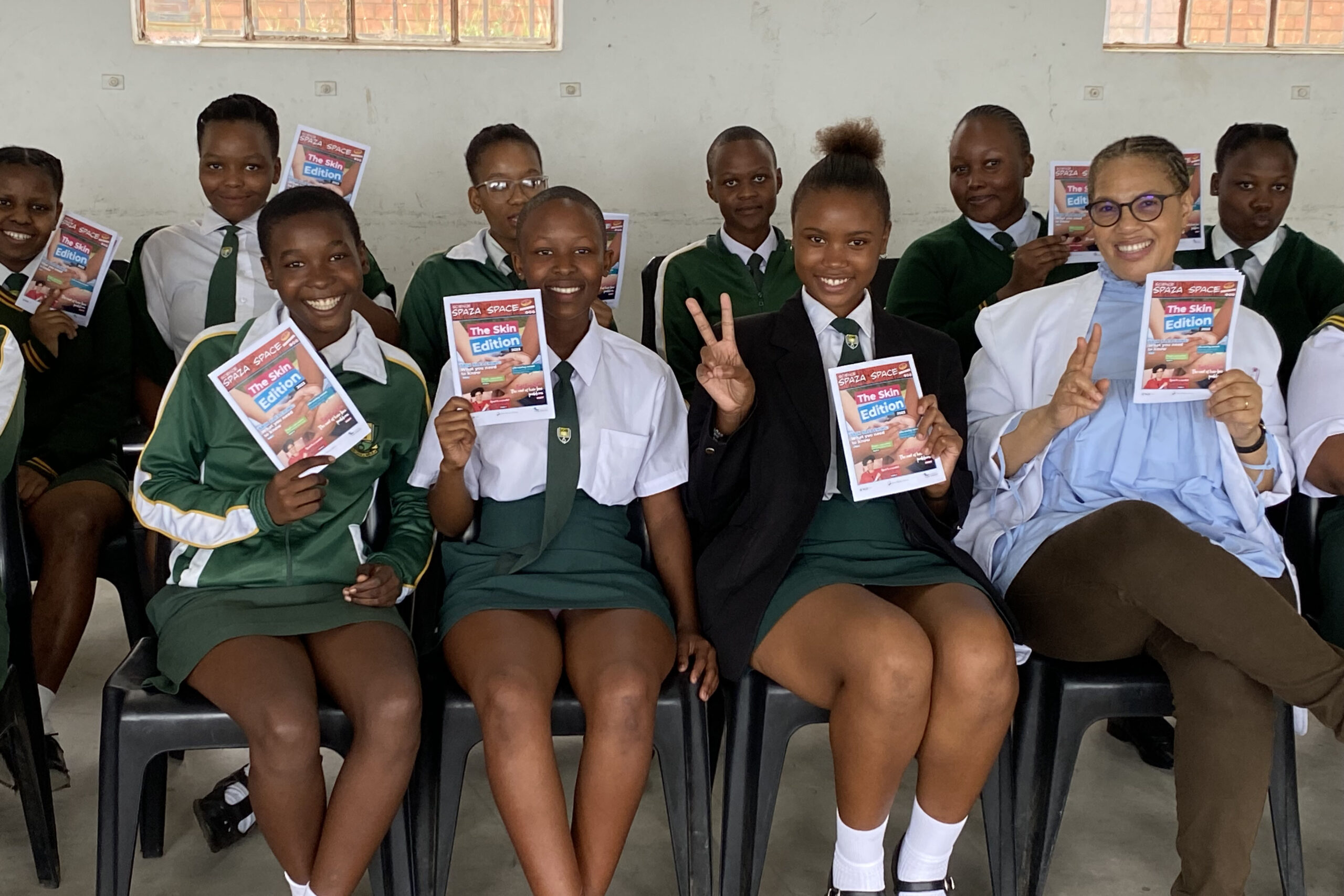
Dr. Dlova created the pamphlet “The Skin Edition” for one of her student outreach programs.
“The medical school used to have student boycotts almost every year because nobody was listening to them,” she said. “I told the students to come to me with their problems so we could talk about them. In the five years I was a dean, there were no boycotts because of this open communication, we listened with an open mind, and we were willing to address their challenges.”
“It’s not just about being first, it’s about the social and political responsibility of being a voice for the community I’m part of.”
She got interest-free loans, for students from under-resourced countries who were unable to pay their fees, from a local bank. And she considered their comfort, creating a student lounge with daybeds for them to relax or sleep between lectures.
Most of her patients speak Zulu, a language unknown to her Indian and white colleagues, making communication difficult. Dlova has been devoted to attracting more Black Africans to the department to improve communication with patients and so students have Black role models. She does this while ensuring there is diversity in the department.
Passive modeling and active mentorship
Dlova embraces the responsibility to train and mentor students that comes from being a pioneer.
“I delayed my PhD to focus on teaching, making sure I had time to mentor Black dermatologists,” she said. “Just being who I am, my authentic self, is a form of passive modelling and mentoring. It’s easier for students to believe they can be dermatologists when they’re taught by someone who looks like them and has achieved this.”
“It’s easier for students to believe they can be dermatologists when they’re taught by someone who looks like them and has achieved this.”
Dlova has mentored more than 40 dermatologists, 80 percent of whom are Black African women. This has transformed the practice of dermatology in South Africa, particularly for African women patients and students. In 2015, she founded, and was the first president of, the South African Women’s Dermatology Society. She has intentionally recruited residents from rural areas, many of whom returned home to establish dermatology clinics. Today, seven of her former students lead dermatology departments, and she continues to support them as they pursue their PhDs.
She was instrumental in forming the Concerned Africans Group to have departments at UKZN better reflect demographics of the population at large. The aim was to have at least half the residents be Black African, and also the heads of departments.
“We looked for people who were capable and had potential,” she said. “I don’t believe in affirmative action, which is something that was once prevalent here. I was never an exceptional student myself; I was quite average.
“So for me, it was about making sure we weren’t missing those who had the credentials and the potential, identifying ordinary candidates from ordinary backgrounds, and grooming them in a nurturing environment to become extraordinary.”
Central centrifugal cicatricial alopecia
Beyond her clinical, teaching, and mentoring roles, Dlova actively conducts research on dermatological conditions affecting people with skin of color, including hair and pigmentation disorders. She was the recipient of the Gold Medal Scientific Merit Award from the South African Medical Research Council (SAMRC) for her research.

Dr. Dlova examines a patient with albinism for skin cancer. People with albinism lack protective melanin, so their risk of developing skin cancer is very high.
She received the South African Medical Association (SAMA) Award for her “stellar contributions to health and research in South Africa”, and she is a National Research Foundation (NRF) B-rated researcher; an acknowledgment of her national and international standing as a well-established researcher. In 2025, the KwaZulu-Natal Doctors Health Consortium (KZNDHC) awarded her the Lifetime Award for her contributions to research, leadership, and her impact on health and medicine in South Africa. She was also honored with the African Health Lifetime Achievement Award by the African Health Excellence Awards in November 2025.
Recent work includes studies on the epidemiology and etiology of central centrifugal cicatricial alopecia (CCCA). CCCA is a common cause of primary scarring alopecia among women of African descent, often following the practice of hair straightening with a hot comb and chemical relaxers. Prevalence among this population can be as high as 5.6% (Malki et al. 2019).
Dlova grew curious about a possible genetic link to CCCA when she treated alopecia in a grandmother and mother, neither of whom had used hair-straightening products. She asked to see the 11-year-old daughter, who also had a small patch of hair loss. This spurred Dlova and her colleagues at Tel Aviv University and Wake Forest Baptist Medical Center in North Carolina to collect biopsies from women with CCCA.

Residents learn about tracking alopecia as they observe Dr. Dlova examine a patient with the skin condition.
Using a variety of sequencing techniques, they identified that 31 percent of the study participants had mutations in the peptidyl arginine deiminase 3 gene. PADI3 is involved in posttranslational modifications of proteins responsible for hair shaft construction (Malki et al. 2019). They concluded that hair-straightening regimes may exacerbate an underlying predisposition to CCCA due to PADI3 mutations.
Skin lightening
Dlova is also passionate about medical education for those with skin of color, such as her campaign about the potential toxicity of skin-lightening practices (Pollock et al. 2021). One-third of Black African and Indian women in South Africa use skin-lightening cosmetic products (Dlova et al. 2014), and ongoing research with colleagues in Senegal has described 55 cases of squamous cell carcinoma caused by skin bleaching.
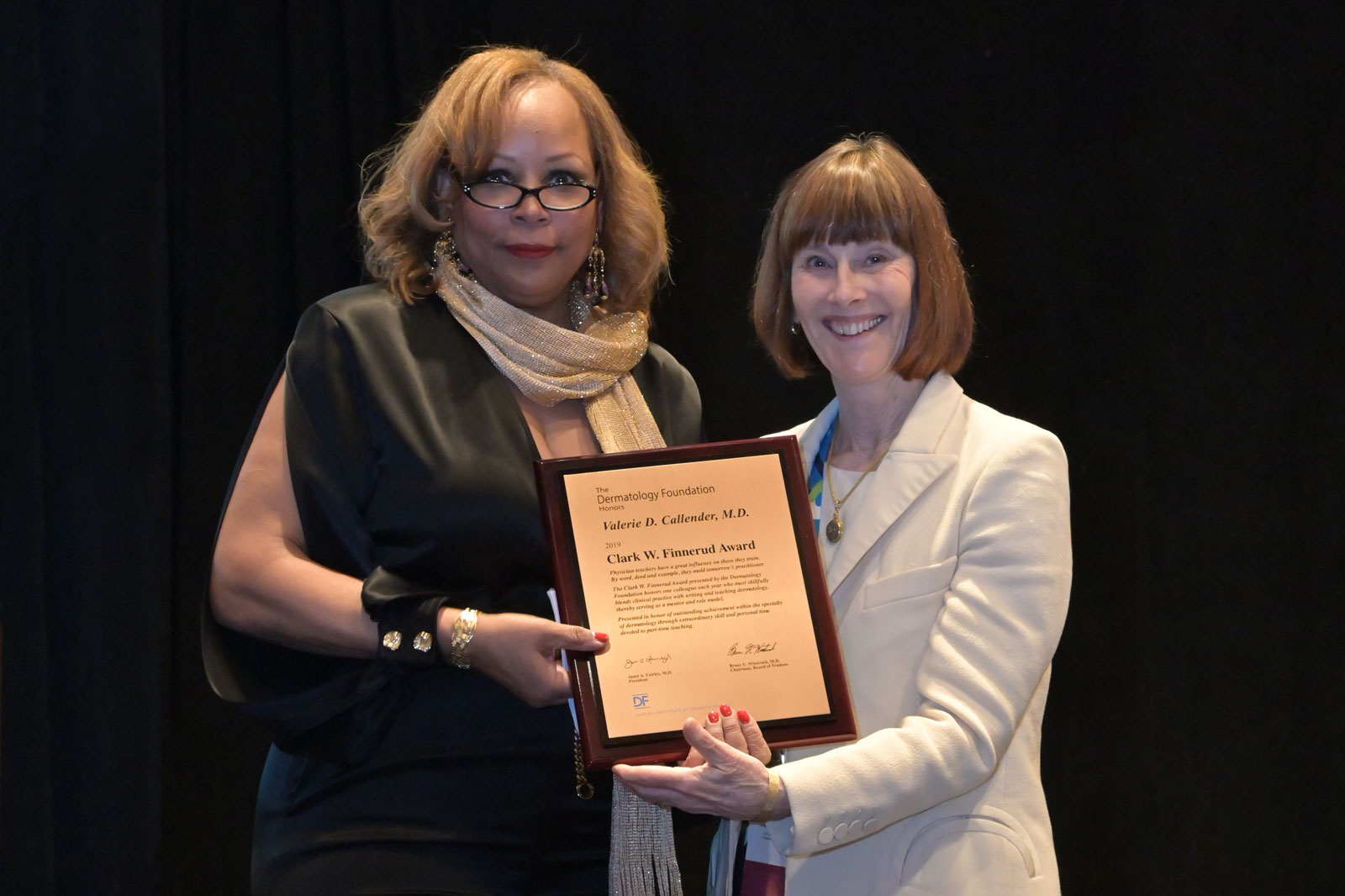
Dr. Valerie D. Callender balances a thriving dermatology practice with influential leadership, research, and mentorship — earning national recognition. A champion for diversity in dermatology, she continues to inspire the next generation through her dedication to teaching and inclusive clinical excellence.
As a board member of the International League of Dermatological Societies (ILDS), she leads a task group that is working to eliminate the global scourge of skin bleaching. They bring together experts, including health advocates, anthropologists, historians, and dermatologists to address this psychosocial and political issue at a global level.
“Medical education is vital in the age of social media, where unfiltered, non-evidence-based information can be easily spread,” Dlova said. “We also want to teach people that the skin they’re born with is the best color. Melanin not only protects Black skin against skin cancer but also slows aging. And of course, younger people who are light skinned need to know that suntanning is not healthy.”
Public education in South Africa, historically aimed at white people, focuses on checking the trunk, back, and limbs for evidence of skin cancer. She wants culturally sensitive education, of the public as well as healthcare professionals, to include checking the feet of Black people, because that’s where melanoma tends to occur in skin of color.
Pushing for pictures of skin of color in textbooks
As a medical student, Dlova’s training consisted of nothing specific to skin of color, while all the images in her textbooks were of white skin. “Textbooks described a lesion as ‘pink’ or ‘light’, which we were not seeing in the majority of our patients,” she said. The lack of images of skin of color in dermatology publications and textbooks is ongoing (Lester et al. 2020; Adelekun et al. 2021), as is research from Ginette Okoye, MD and her colleagues showing the low enrolment in clinical trials of people with Black skin (Okeke et al. 2022).
As in so much of her career, Dlova found a solution to the problem—she co-wrote her own dermatology textbook. Dermatology: A Comprehensive Handbook for Africa covers skin conditions that are commonly seen in skin of color. Dlova has also contributed chapters to Taylor and Kelly’s dermatology for skin of color, 2nd edition (Taylor and Kelly 2016), and creates lessons on such topics as atopic eczema and psoriasis in those with darker skin for Lecturio, an online dermatology education platform (Dlova 2025).
“I also contribute pictures to VisualDx [a company that supports visualization of medical conditions to support diagnosis], which has a comprehensive collection of pictures of Black skin,” Dlova said. “I feel there’s been progress in terms of being inclusive of these conditions that affect skin of color.”
Dlova has reshaped South African dermatology, and her transformative leadership as former dean has ensured that Black South Africans see themselves represented — in training, in the clinic, in leadership roles, in academia, and in the literature of her field.

Dr. Dlova’s outreach work includes teaching high school students how to care for their skin and hair.
By breaking new ground, she has created opportunities for peers and students while elevating the care of those with skin of color.
Dlova continues to unify the African continent by representing African dermatologists on the ILDS board and, since 2022, by establishing monthly Africa-wide grand rounds in which dermatologists from across the continent present intriguing cases online. In addition, she is the co-founder of the African Skin of Color Society (established in 2024) and represents Africa in the Global Skin of Color Alliance.
Taken together, Dlova’s contributions reflect a sustained commitment to advancing dermatology for Africans and strengthening the structures that support those who care for skin of color.
References
Adelekun A, Onyekaba G, Lipoff JB. Skin color in dermatology textbooks: an updated evaluation and analysis. J Am Acad Dermatol. 2021;84(1):194–196.
Dlova N, Hamed SH, Tsoka-Gwegweni J, et al. Women’s perceptions of the benefits and risks of skin-lightening creams in two South African communities. J Cosmet Dermatol. 2014;13(3):236–241. https://onlinelibrary.wiley.com/doi/10.1111/jocd.12104
Dlova NC, Hamed SH, Tsoka-Gwegweni J, et al. Skin lightening practices: an epidemiological study of South African women of African and Indian ancestries. Br J Dermatol. 2015 Jul;173 Suppl 2:2-9.
Dlova N and Mosam A. Dermatology: A Comprehensive Handbook for Africa. Durban, South Africa: University of KwaZulu-Natal; 2017.
Dlova NC. Atopic Eczema in Darker Skin: Epidemiology and Pathophysiology. Lecturio. https://app.lecturio.com/#/lecture/s/103537/262739?return=/search/dlova. Accessed September 22, 2025.
Lester JC, Jia JL, Zhang L, Okoye GA, Linos E. Absence of images of skin of colour in publications of COVID-19 skin manifestations. Br J Dermatol. 2020;183(3):593–595. https://onlinelibrary.wiley.com/doi/10.1111/bjd.19258
Madison K. Essential Textbooks for Dermatology in Skin of Color. Mahogany Dermatology. https://www.mahoganydermatology.com/news/essential-textbooks-for-dermatology-in-skin-of-color. Edited 2025. Accessed September 22, 2025.
Malki L, Sarig O, Romano MT, et al. Variant PADI3 in Central Centrifugal Cicatricial Alopecia. N Engl J Med. 2019;380(9):833–841. https://www.nejm.org/doi/full/10.1056/NEJMoa1816614
Okeke CAV, Perry JD, Simmonds FC, et al. Clinical trials and skin of color: The example of hidradenitis suppurativa. Dermatology. 2022b;238(1):180–184. https://www.karger.com/Article/FullText/516467
Pollock S, Taylor S, Oyerinde O, et al. The dark side of skin lightening: An international collaboration and review of a public health issue affecting dermatology. Int J Womens Dermatol. 2020;7(2):158–164. https://www.sciencedirect.com/science/article/pii/S2352647520301416
Taylor S, Kelly P, Lim H, et al. Taylor and Kelly’s dermatology for skin of color, 2nd edition. New York, NY: McGraw Hill; 2016.