
Advancing Dermatology for Latino Skin of Color
Through mentorship, clinical leadership, and research, Dr. Maritza Perez has influenced dermatology education, expanded clinical practice, and advanced care for Latino skin of color. Maritza I. Perez is the 2026 recipient of DF Practitioner of the Year Honorary Award
June 2026
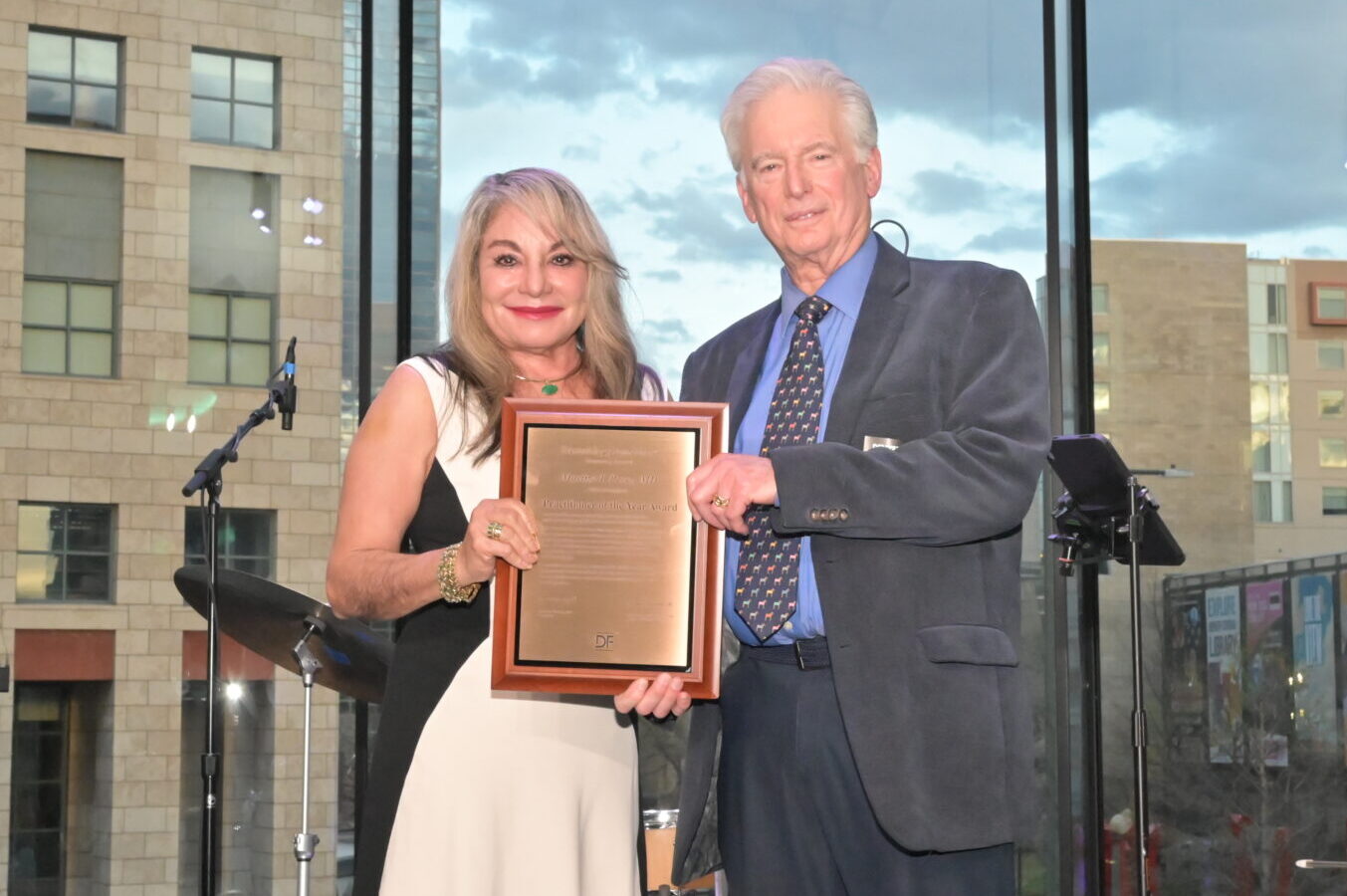

Maritza Perez, MD, is an indefatigable teacher who has mentored hundreds of residents since 1984 when she graduated from a dermatology residency in Puerto Rico. As a clinician, she made her mark by performing tens of thousands of Mohs surgeries, laser treatments, and cosmetic procedures, particularly in Latino skin of color. Perez, who retired in 2025 from her role as professor at the University of Connecticut School of Medicine (UConn) and as clinical professor at the Mount Sinai Health System, continues to teach parttime.
“Being a female Hispanic with skin of color, you would be surprised to learn that all my mentors have been white males,” she said, naming fellow dermatologists, Drs. Richard Edelson, Perry Robin, and Vincent DeLeo. “I adore and admire these men because of the indelible marks they’ve made on the progress of dermatology, as well as for mentoring me and many people like me.”

Now officially retired from her full-time position at the University of Connecticut, Perez is a recognized expert in Mohs surgery, laser dermatology, and cosmetic procedures, with an extensive body of published work.
She was the first in her family to go to college and graduated from the University of Puerto Rico School of Medicine. After completing her residency, Perez received a fellowship in immunodermatology at the Columbia University College of Physicians and Surgeons, where she worked with Edelson. When he became chair of the Department of Dermatology at Yale University, he insisted Perez join him in New Haven, where she was an attending physician for seven years. There, she taught residents and researched the cellular immunology of photophoresis, a process Edelson invented. Her findings contributed evidence that showed how photophoresis could be used to reduce rejection rates in heart and lung transplant patients as well as treatment for graft vs. host disease (Perez et al. 1989).
When Perez gave birth to twin girls, she recognized that the long hours of research were incompatible with raising children and chose to pursue a fellowship in Mohs surgery and cosmetics with Robins at the New York University Langone Medical Center. She stayed on in New York to work with DeLeo at St. Luke’s Roosevelt Hospital Center (now Mount Sinai Morningside) where she was a clinical professor, mentoring residents and conducting research into laser treatments of skin conditions. While there, Perez was awarded Best Teacher in Cosmetic Dermatology (2015–2019) at the Mount Sinai Icahn School of Medicine.

Perez, center, championed resident autonomy and received the 2025 UConn Teaching Award. She mentored UConn residents Christian Gronbeck, left, and Albert Zhou for Mohs fellowships; in addition to their assigned rotations, both chose to rotate with Perez during their free time.
Skin cancer, Mohs surgery, and Latino skin
Perez ran a private clinic for a number of years in New Canaan, CT, before being invited to join the staff at UConn in 2019. For more than two decades, she performed dozens of Mohs surgeries each week. She has a passion for public education to improve early detection and prevention of skin cancer, knowing that with better awareness many such surgeries could be avoided. Her advocacy began long before it became fashionable, through her involvement with the Skin Cancer Foundation, of which she is senior vice president, and within the Hispanic community. She also co-authored a textbook, Understanding Melanoma, to help the public understand the need for sun protection (Robins and Perez 2015).
“There was a false belief, including among dermatologists, that Hispanics with darker skin were not prone to melanoma, did not need to have complete skin exams, and did not need to protect their skin from the sun,” Perez said.
While the lifetime risk of having melanoma is three percent for those with white skin and 0.5 percent for Hispanics (American Cancer Society 2026), Hispanics have higher mortality rates, likely due, in part, to poorer screening and a decline in sun-protective behaviors (Perez 2019). To counteract the myths, she sought to educate dermatologists about the need to be aware of melanoma in their patients with skin of color (Alexis et al. 2021).
“There was a false belief, including among dermatologists, that Hispanics with darker skin were not prone to melanoma, did not need to have complete skin exams, and did not need to protect their skin from the sun.”
Perez was a member of the board of directors of the Skin of Color Society (2018–2021) and still maintains her affiliation, to continue providing education to dermatologists and the public, as well as to act as a role model for future dermatologists.
Perez believes that members of a good dermatology department have to have a background in clinical dermatology, understand the latest treatment and medication advancements, and, in surgical dermatology, have a breadth of knowledge to treat skin cancers in a multidisciplinary way.
Immunodermatology in skin of color
Perez, with Susan Taylor, drafted a consensus statement and recommendations for skin care in people with skin of color, based on skin barrier properties that influence atopic dermatitis (AD), pruritis, and other skin conditions differently depending on skin tone (Alexis et al. 2021).
While these immunological diseases are seen in all races, they are more prevalent and cause greater morbidity in patients of African-American, Asian, and Hispanic descent, in part due to racial and ethnic variations in ceramide levels and lack of filaggrin due to genetic mutations that adversely affect the skin barrier.
The authors argued for more rigorous clinical studies to understand how variations in the skin barrier adversely affect those with skin of color.
“Most of the research on life-changing immunomodulators was conducted in Caucasian patients,” Perez said. “Since we published that consensus statement, the number of skin of color patients has increased in every single trial. We now can show that they respond differently to these medications, which has allowed for more targeted treatments.”
Perez was recruited to UConn in 2019 to do Mohs surgery. She began twice a week while continuing to run her aesthetic dermatology private practice. In 2021, she closed her practice and donated all her lasers and other equipment to UConn to help create a laser center.
“Since we published that consensus statement, the number of skin of color patients has increased in every single trial. We now can show that they respond differently to these medications, which has allowed for more targeted treatments.”
While there, she studied how to use selective photothermal lysis to target either blood vessels, pigment, or water in skin, each of which has a unique absorption curve, with different wavelengths of laser light used to treat traumatic scarring (Nijhawan and Perez 2014), keloids (Rossi et al. 2013), and acne scars (Lipper and Perez 2006).
She showed that the wavelength of laser light used depends on the color of a patient’s skin and has to be adjusted for darker Latino skin (Rossi and Perez 2011). For example, when targeting pigment in white skin, clinicians typically use lasers with a wavelength of 755 nm, whereas in Latino skin they rely on 1064 nm that targets deeper layers of melanin and avoids absorption by surface melanin, which would cause blisters.
DF Honorary Practitioner of the Year Award
In recognition of an outstanding full-time clinician who epitomizes the best of clinical service to the individual patient. The Practitioner of the Year Award presented by the Dermatology Foundation® honors one colleague each year whose outstanding record of private practice and professional leadership establishes them as model physicians and examples of excellence and commitment for both their colleagues and future generations of dermatologists.
Presented in honor to an individual who skillfully blends all professional activities with an enduring commitment to being a dermatologist who provides the best possible clinical service to each patient.
Dermatology Foundation relationship
Perez has been a strong financial supporter of the Dermatology Foundation for more than 25 years. She has been an Annenberg Circle Sustainer (i.e., continuing to contribute at least $5,000 annually beyond the original commitment of $25,000) since 2010.
“The Dermatology Foundation has helped build the careers of many people, including mine,” said Perez, who received a grant (1985) and a fellowship (1986) from the Foundation. “This funding was instrumental to me and it’s imperative that we contribute if we can. We’ve been accepted into a privileged group, and we need to make opportunities available for the ones that are coming behind us.”
In addition to supporting young careers, Perez pointed out that contributing to the Foundation supports research grants that result in new dermatological medications that improve the survival of patients.
Continuing to teach in retirement
Perez wants to enjoy life away from work, feeling she’s contributed enough. It’s a feeling the residents she trained echoed in a social media post when she retired: “She championed resident autonomy and invested in our growth. From joining UConn in 2019, she has set a standard of care and compassion that will continue to inspire us.”

“She championed resident autonomy and invested in our growth. Since joining UConn in 2019, she has set a standard of care and compassion that will continue to inspire us.”
Perez’s career is a testament to dedication, innovation, and mentorship in dermatology. Her advancement of the understanding and treatment of skin conditions in Latino skin of color has left an indelible mark on patients and trainees alike. Her work in Mohs surgery, laser treatments, and immunodermatology, combined with tireless advocacy for education and research, has expanded opportunities for future generations of dermatologists and improved outcomes.
“I’ve been working since I turned 16,” she said. “If I keep working, I won’t have time to enjoy the things I missed while I was working. I did 800 Mohs surgeries every year, I’ve done reconstructive surgeries, and I’ve collaborated with multiple specialties. I am very proud to have saved the lives of many of my patients. But I’ve done all the surgeries that I wanted to do.”
Nominate a colleague for a DF Honorary Award.
References
Alexis AF, Woolery-Lloyd H, Williams K, et al. Racial/Ethnic Variations in Skin Barrier: Implications for Skin Care Recommendations in Skin of Color. J Drugs Dermatol. 2021;20(9):932–938.
American Cancer Society. Key Statistics for Melanoma Skin Cancer. 2026. https://www.cancer.org/cancer/types/melanoma-skin-cancer/about/key-statistics.html
Hanley AJ. What One Derm Wants You to Know About Advanced Non-Melanoma Skin Cancer—No Matter Your Skin Color. Prevention. 20 December 2023.
Lipper GM, Perez M. Nonablative acne scar reduction after a series of treatments with a short-pulsed 1,064-nm neodymium:YAG laser. Dermatol Surg. 2006;32(8):998–1006.
Nijhawan RI, Perez MI. Successful use of 1064 Nm Nd:YAG in conjunction with 2790 Nm YSGG ablative laser for traumatic scarring. J Drugs Dermatol. 2014;13(1):80–81.
Perez M, Edelson R, Laroche L, et al. Inhibition of antiskin allograft immunity by infusions with syngeneic photoinactivated effector lymphocytes. J Invest Dermatol. 1989;92(5):669–676.
Perez MI. Skin Cancer in Hispanics in the United States. J Drugs Dermatol. 2019;18(3):s117–120.
Robins P, Perez M. Understanding Melanoma: What you need to know. Skin Cancer Foundation; 2015.
Rossi A, Lu R, Frey MK, et al. The use of the 300 microsecond 1064 nm Nd:YAG laser in the treatment of keloids. J Drugs Dermatol. 2013;12(11):1256–1262.
Rossi AM, Perez MI. Laser therapy in Latino skin. Facial Plast Surg Clin North Am. 2011;19(2):389–403.