
A Career Defined by Research, Leadership and Mentorship
Bruce Wintroub, MD, is the recipient of the 2026 DF Distinguished Service Medallion
October 2026
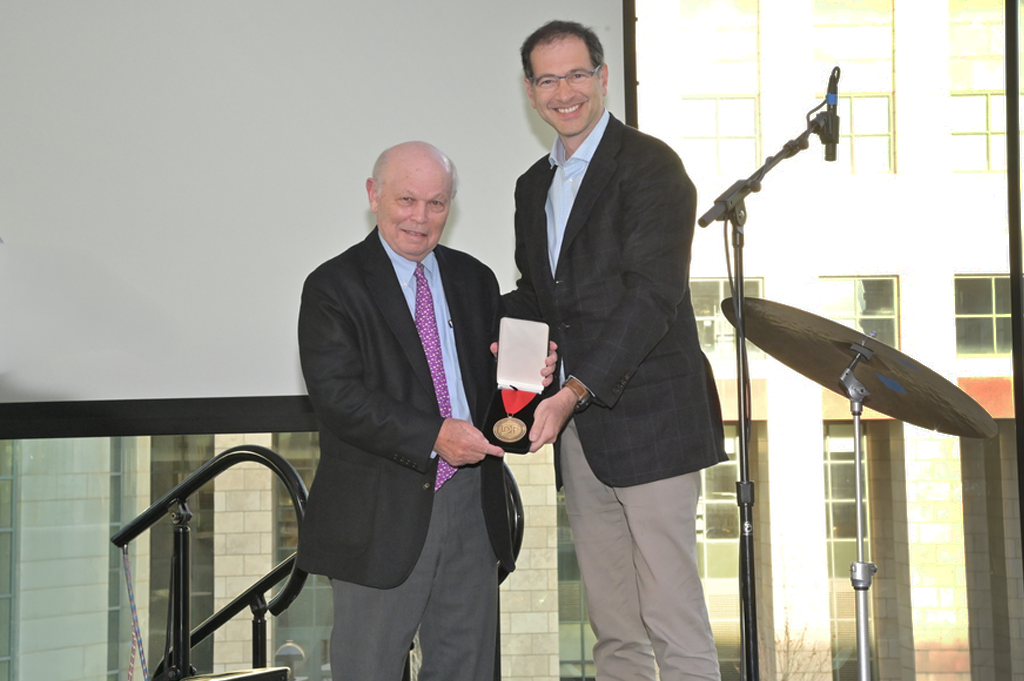


In 1982, Wintroub became director of faculty practice, associate professor and vice chair in the Department of Dermatology at UCSF. He held the position of chair of the department from 1985 until he retired in 2022.
The breadth of his clinical research discoveries, his advocacy for gender parity and ethnic diversity, and his accomplishments as a leader and mentor to generations of dermatologists are a testament to the immeasurable impact Bruce Wintroub, MD, has had on dermatology.
If the dermatology program at UCSF is as robust and as academically and clinically important nationally, it is largely because of his leadership as chair for more than 35 years.
In recognition of this lifelong service to dermatology, as well as his huge contributions to the Dermatology Foundation, Dr. Wintroub is the Foundation’s 2026 recipient of the Distinguished Service Medallion. He joins an elite group of only eight dermatologists who have received this award since 1989.
Honorary Distinguished Service Medallion
The Distinguished Service Medallion is the highest honor the Foundation confers on a colleague in recognition of exemplary leadership and service to the specialty of dermatology.
This prestigious award is a fitting tribute to a fellow dermatologist who is an inspirational role model for future generations, and whose guiding vision and commitment have had a profound impact on dermatology.
Biographical sketch
Wintroub received his medical degree from Washington University in St. Louis (1969), before pursuing a cardiology fellowship at Stanford University. He was unsure what he wanted to specialize in when he became a fellow in Frank Austen’s immunology lab at Peter Bent Brigham Hospital (Brigham). It was in Austen’s lab that he met the dermatologists who encouraged him to spend time in the dermatology clinic.
“It turned out I enjoyed it,” Wintroub said. “I told Frank that I wanted to be a dermatologist and he got me a residency at Harvard with Tom Fitzpatrick.”
Wintroub spent two years at Harvard Medical School (Harvard), continued for another two-years as an instructor in dermatology, and then four more years there as a consultant and assistant professor.
In 1982, he moved to San Francisco where he became director of faculty practice, associate professor and vice chair in the Department of Dermatology at UCSF. He held the position of chair of the department from 1985 until he retired in 2022.
From physician-scientist to academic leader
Wintroub’s clinical research was foundational, in particular his work on human skin mast cells and chemotherapy treatments for cutaneous t-cell lymphoma (CTCL).
He was an early clinical investigator drafted into clinical studies of photophoresis by his friend, Richard Edelson, who developed the technique to treat CTCL (Edelson et al. 1987). They were able to show that photophoresis could induce remissions and extend survival (Heald et al. 1992).
Although biologics, such as monoclonal antibodies, have largely supplanted photophoresis for the treatment of CTCL, the technique is still used to allay graft-versus-host disease following bone marrow transplantation, as well as Crohn’s disease and other conditions (Knobler et al. 2020).
It was in the early 1970s, as a research fellow in Austen’s lab at Brigham, that Wintroub became interested in immunology and the science of inflammation. They studied the role of mast cells in immediate hypersensitivity and autoimmune skin diseases, notably bullous pemphigoid.
The prevailing understanding at the time was that mast cells were part of an allergic reaction. Their research revealed that mast cells were also actively involved in inflammation and tissue damage in bullous pemphigoid through activation of the complement system (Wintroub et al. 1978). Mast cell degranulation — the release of inflammatory factors — triggered eosinophils recruitment, resulting in the characteristic blisters of bullous pemphigoid.
At UCSF, Wintroub continued to work with Austen and together he and his mentor published dozens of articles elucidating the mechanisms behind mast-cell involvement, including the identification of multiple proteases that are released from mast cell granules and mediate the disease process (Schwartz et al. 1985; Wintroub et al. 1986; Goldstein et al. 1987).
Wintroub’s group subsequently purified, characterized, and cloned human mast cell carboxypeptidase (Natsuaki et al. 1992). This work demonstrated that mast cells were not only releasing histamines but that their granules contain multiple proteases that affect inflammation and disease progression.
“My career in dermatology started with research and that opened doors for me, but I enjoyed building the department, managing the school, and developing people much more.”
Wintroub continued this research until he was chair at UCSF where became so busy running the department, he felt he could no longer be an effective scientist. “My career in dermatology started with research and that opened doors for me,” Wintroub said. “I really did enjoy it, but I enjoyed building the department, managing the school, and developing people much more.”
Training and mentoring
Over nearly four decades as chair, Wintroub propelled the Department of Dermatology at UCSF into a renowned hub of clinical care, research, and education. “These are the three main activities of any clinical department,” he said.
“Some people we hired were strong clinicians and teachers; others were strong researchers. They were all, from my point of view, equally important to a high-functioning department.”
At UCSF Wintroub expressed the need for better dermatology training for primary-care physicians (Branch and Wintroub 1983; Branch et al.1983) because he saw a need and wanted to be sure that when primary-physicians came to his department, they were well cared for and their needs were met.
“I saw my main role as chair of the department as being responsible for the career development of young people,” he said. “To see young people thrive became my job, and I cherished that role.”
“Bruce’s support for physician-scientists who were residents or junior faculty was amazing and unparalleled. He was unconditionally supportive during his tenure as the department chair. He understood the challenges of being a physician-scientist because he was one himself and he used departmental resources to help us overcome them.”
Michael Rosenblum, MD, PhD
One of those people is Michael Rosenblum, MD, PhD, professor of dermatology, UCSF School of Medicine. Rosenblum was recruited to the department during Wintroub’s tenure as chair and worked under him for 15 years.
“Bruce’s support for physician-scientists who were residents or junior faculty was amazing and unparalleled,” said Rosenblum. “He was unconditionally supportive during his tenure as the department chair. He understood the challenges of being a physician-scientist because he was one himself and he used departmental resources to help us overcome them.”
Rosenblum pointed to Wintroub’s understanding of the allure of private practice for a struggling researcher and his implementation of a department-funded program for junior faculty to hire a technician to support lab research.
“This was unheard of,” Rosenblum said. “Usually, an independent investigator would have to get multiple grants before they got their first technician. We continue to follow his example with this practice in the department.”
An advocate for diversity in dermatology
Wintroub advocated over the years for greater racial and ethnic diversity, as well as gender equality, in dermatology.
“There were only three women in my medical school class, but by the time I became a dermatologist, half of medical students were women,” Wintroub said. “I did the best I could to appoint women to leadership positions. That developed over time in a very natural way as I simply followed the demographics of those entering into medicine.”
He also played a role in increasing racial diversity in dermatology. Historically, the school was not seeing a lot of people of color applying to dermatology.
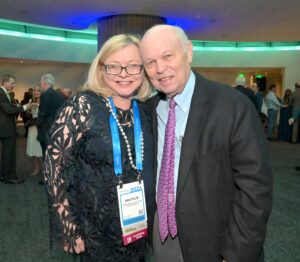
Dr. Renee Mathur, secretary-treasurer of the Foundation and co-chair of the Leaders Society (left), and Dr. Bruce Wintroub at the 2026 Annual Meeting of Membership.
“That became a concern of mine during the year I was dean of the medical school,” Wintroub said. “The medical students made it absolutely clear to the management of the medical school that this was an important issue. I took it to heart because I believed it.”
Wintroub took a public stance 10 years ago (Pandya et al. 2016), to ensure dermatology and his department in particular, demonstrated diversity. He and his colleagues at the university began programs to promote diversity in clinical care, research, and education (Torres et al. 2019).
Among the significant trainings he instituted was a skin of color and cultural competence curriculum for dermatology residents. This helped create an inclusive environment that attracted and retained residents and faculty that had been historically underrepresented in dermatology.
Supporting young investigators through the Foundation
Wintroub joined the Dermatology Foundation in 1989 and served various roles until he retired in 2022, including on the Executive Committee, as president, and as chair.
“I enthusiastically agreed to participate in the leadership at the Foundation because it fit exactly with my passion to launch young people into their careers. We were trying to fund people who were doing scientific research.”
“For me, the Derm Foundation was the most important thing in dermatology,” Wintroub said. “I enthusiastically agreed to participate in the leadership at the Foundation because it fit exactly with my passion to launch young people into their careers. We were trying to fund people who were doing scientific research.”
Over the years, Wintroub has helped raise more than $60 million for the Foundation, an astounding figure that attests to his commitment to his chosen field. Raising funds allowed the Foundation to change the grants it offered from single-year stipends to, among other awards, three-year Career Development Awards.
“His fundraising has been transformative,” said Rosenblum, who received a fellowship from the Foundation (2009), a CDA (2010–2012), and was named a Stiefel Scholar (2015).
“As a medical student thinking about being a physician-scientist, you need to gauge which specialties will allow you to have protected time and funding to dedicate towards research. The Derm Foundation is one of those entities, and the awards program allows early investigators to get off the ground and start running. One of the reasons I chose dermatology was for this support.”
When he retired, Wintroub also stepped back from his involvement with the Foundation.
“The Foundation has developed some of the best people that entered the field over the last 35 years. I hope the generation after me will see it the way I did and make it even better.”
“I was almost 80 years old, and it was time for the people we were training to take over, he said.
“The Foundation has developed some of the best people that entered the field over the last 35 years. I hope the generation after me will see it the way I did and make it even better.”
Bruce Wintroub’s legacy spans significant scientific, clinical, and academic contributions in dermatology. His early, sustained research on mast cell biology contributed to our understanding of inflammatory skin diseases, while he advanced the clinical treatment of cutaneous lymphoma. His long tenure developing the Department of Dermatology at UCSF, in addition to his senior leadership at the School of Medicine, represents a great institutional contribution. Through these achievements, Wintroub has left a lasting mark on dermatology as a physician-scientist, mentor, and leader.
Donate to the Dermatology Foundation to support research that invests in your future.
References
Blacker KL, Stern RS, Wintroub BU. Cutaneous drug reactions. In: Fitzpatrick TB, Eisen AZ, Wolff K, Freedberg IM, Austen KF, eds. Dermatology in General Medicine. 4th ed. McGraw-Hill; 1993:1783–1795.
Branch WT Jr, Wintroub BU. Dermatologic training for nondermatologists. J Am Acad Dermatol. 1983;9(2):281–283.
Branch WT Jr, Collins M, Wintroub BU. Dermatologic practice: implications for a primary care residency curriculum. J Med Educ. 1983;58(2):136–142.
Edelson R, Berger C, Gasparro F, et al. Treatment of cutaneous T-cell lymphoma by extracorporeal photochemotherapy. Preliminary results. N Engl J Med. 19875;316(6):297–303.
Goldstein, SM, Kaempfer CE, Proud D, et al. Detection and partial characterization of a human mast cell carboxypeptidase. J Immuno. 1987;139(8):2724–2729.
Heald P, Rook A, Perez M, et al. Treatment of erythrodermic cutaneous T-cell lymphoma with extracorporeal photochemotherapy. J Am Acad Dermatol. 1992;7(3):427–433.
Hunziker T, Boillat C, Gerber HA, et al. In vitro pemphigus vulgaris model using organotypic cultures of human epidermal keratinocytes. J Invest Dermatol. 1989;93(2):263–267.
Knobler R, Arenberger P, Arun A, et al. European dermatology forum – updated guidelines on the use of extracorporeal photopheresis 2020 – part 1. J Eur Acad Dermatol Venereol. 2020;34(12):2693–2716.
Natsuaki M, Stewart CB, Vanderslice P, et al. Human skin mast cell carboxypeptidase: functional characterization, cDNA cloning, and genealogy. J Invest Dermatol. 1992;99(2):138–45
Pandya AG, Alexis AF, Berger TG, Wintroub BU. Increasing racial and ethnic diversity in dermatology: A call to action. J Am Acad Dermatol. 2016;74(3):584–587.
Schwartz LB, Bradford TR, Littman B, Wintroub BU. The fibrinogenolytic activity of purified tryptase from human lung mast cells. J Immunology. 1985;135:2762–2767.
Shinkai, K, Stern RS, Wintroub BU. Cutaneous drug reactions. In: Kasper DL, Fauci AS, Hauser SL, Longo DL, Jameson JL, Loscalzo J, eds. Harrison’s Principles of Internal Medicine. 19th ed. McGraw Hill; 2015:377–385.
Stern RS, Wintroub BU, Arndt KA. Drug reactions. J Am Acad Dermatol. 1986;15(6):1282–1288.Torres J, Adekunle L, Shinkai K, et al. 237 Diversity in dermatology: the UCSF experience. Epidemiology. 2019;139(5):S41.
Wintroub BU, Mihm MC Jr, Goetzl EJ, et al. Morphologic and functional evidence for release of mast-cell products in bullous pemphigoid. N Engl J Med. 1978;298(8):417–421.
Wintroub BU, Kaempfer CE, Schecter NM, et al. A human lung mast cell chymotrypsin‑like enzyme: identification and partial characterization. J Clin Invest. 1986;77(1):196–201.